 Skip-the-line available
 Belvedere, Half a Day, or a Full Vienna Day: Three Honest Itineraries
The tight essential circuit, the unhurried two-palace morning, and the version that folds Belvedere into a full Vienna art day — with timings built on the opening hours as they actually are.
Every Belvedere itinerary is really an answer to one question: how much of your Vienna time does the palace deserve? The honest answer depends on what you came for. If it is The Kiss and the essence of the collection, two well-planned hours in the Upper Belvedere deliver it completely. If it is the full ensemble — Klimt and Schiele, the Marble Hall, Girard’s garden axis, and the exhibitions in Prince Eugene’s residential palace below — a half day fits it comfortably. And if Belvedere is one movement in a larger Vienna art day, the palace pairs with Schönbrunn or the Ringstrasse museums better than any comparable sight in the city. This guide lays out all three plans with clock times, built on the operator’s published hours: Upper Belvedere daily from 09:00 (closing 18:00, extended to 19:00 from 15 July to 31 August 2026), Lower Belvedere daily 10:00 to 18:00, Belvedere 21 Tuesday to Sunday 11:00 to 18:00 with Thursdays to 21:00, and last admission thirty minutes before closing everywhere. Time slots are required for the Upper and Lower palaces — but once inside, your stay is unlimited, which is the fact all three plans exploit.
The constraints that shape any plan
Four fixed facts do most of the planning for you. First, the stagger: the Upper Belvedere opens at 09:00, the Lower not until 10:00, which settles the order of any two-palace day — Upper first, always. Second, timed entry: admission to both palaces runs on time-slot tickets, so the plan you choose needs to exist before you arrive, not at the ticket desk; the slot fixes your entry time only, and the length of your stay is unlimited once you are inside. Third, last admission falls thirty minutes before closing, which quietly deletes the fantasy of a meaningful visit begun at 17:15. Fourth, the two palaces are separated by the formal Baroque garden — a ten-to-twelve minute downhill walk along the central axis — which is not dead time between venues but one of the finest stretches of the visit, and effectively a third venue in good weather.
One more fact works silently in your favour: the Belvedere’s crowd curve. The Klimt rooms are calmest in the first hour after opening and fill steadily from late morning as tour groups land, peaking through the early afternoon. Every itinerary below therefore starts at 09:00 — not because early starts are virtuous, but because an hour at the Belvedere at 09:00 is worth two at 13:00. Visitors locked into an afternoon arrival should invert the museum: surrounding Klimt and Schiele rooms first, the famous wall when a gap opens, and the ground floor last. Monday, incidentally, is a legitimate choice — unlike most great European museums, the Upper and Lower Belvedere open seven days a week.
The two-hour essential: Upper Belvedere only
Book the 09:00 slot for the Upper Belvedere and arrive a few minutes ahead. Coats and every bag into the free lockers — the house rules require it anyway, and it makes the next two hours lighter — then go directly up the grand staircase, against the instinct to start on the ground floor. From roughly 09:05 to 09:50 you have the first floor at its emptiest: The Kiss and the surrounding Klimt galleries first, while the famous wall is at its quietest of the entire day, then the golden Judith and the portraits in the adjacent rooms. Give the Marble Hall ten unhurried minutes — the two-storey ceremonial hall where the Austrian State Treaty was signed in 1955 sits at the top of the staircase, and at this hour you may have its marble floor to yourself.
From about 10:00, work through the Schiele rooms — Death and the Maiden, The Family — and Messerschmidt’s character heads as the building begins to fill, then descend to the ground-floor galleries for the medieval and earlier collections at a brisker pace. By 10:45 you have seen the collection’s spine without once standing in a queue. Spend the last quarter hour outside: exit to the garden side, walk a terrace or two of the parterres for the palace-and-pond view, and you are done by 11:00 with the whole day ahead. This is the itinerary we build for visitors with a train to catch or a packed Vienna schedule — it sacrifices depth on the ground floor and the Lower Belvedere entirely, and sacrifices nothing that headlines the visit.
The half day: two palaces and the garden axis
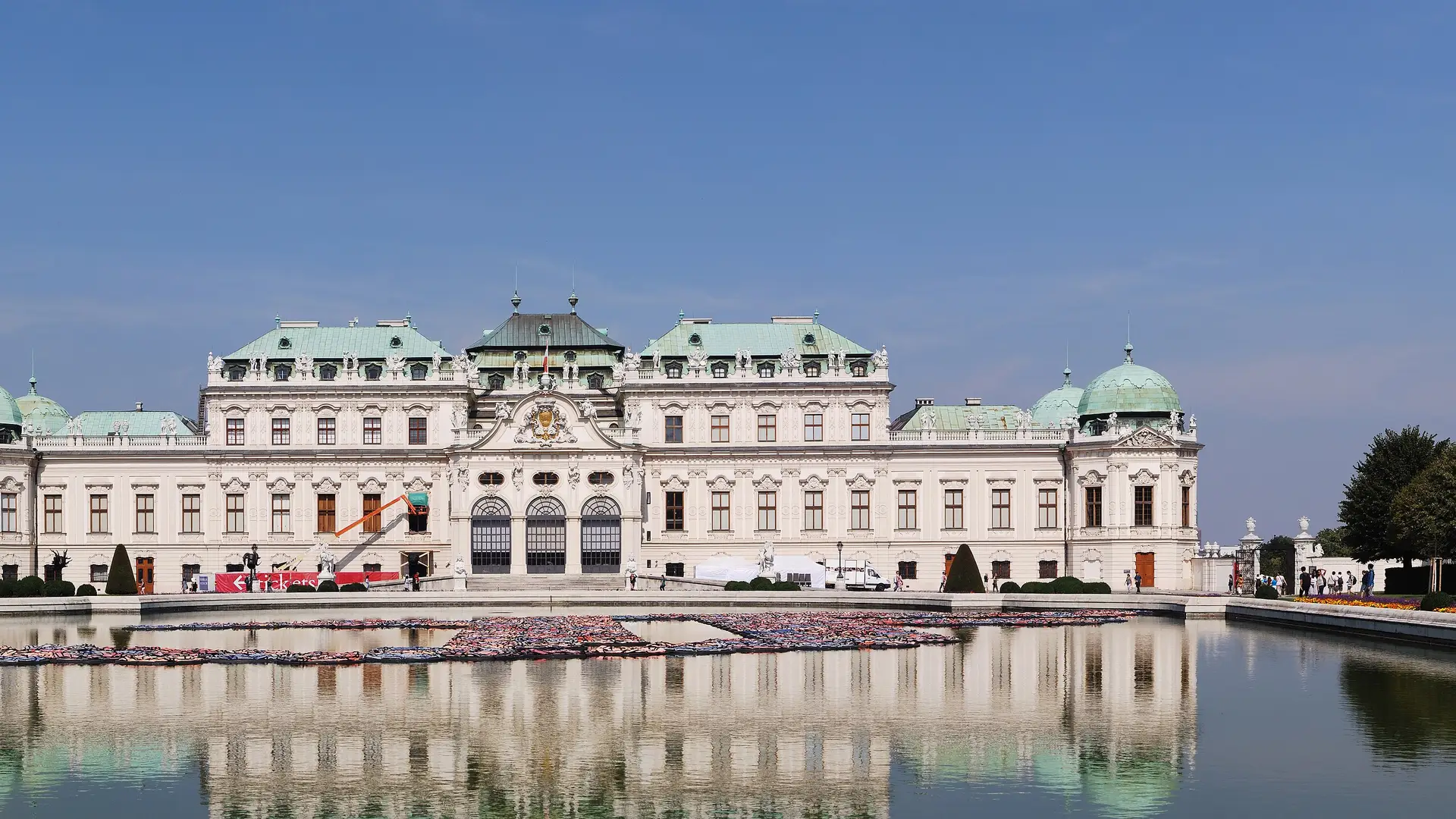
The half-day plan begins identically — 09:00 slot, first floor first — but decompresses everything. Take until 10:30 or so in the Upper Belvedere: the Klimt rooms without watching the clock, the Schiele group properly, the Marble Hall’s garden view, a real pass through the ground floor. Then walk out into the garden and descend the central axis toward the city — ten to twelve minutes of terraces, fountains and sphinxes, with the palace behind you composing itself for photographs at every landing. The descent lands you at the Lower Belvedere conveniently after its 10:00 opening, ahead of its own midday build-up.
The Lower Belvedere is a different museum in kind: Prince Eugene’s actual residential palace, staging temporary exhibitions through its Baroque state rooms — the Marble Gallery, the Hall of Grotesques, the Golden Room — with further exhibition space in the Orangery and the medieval collection displayed in the former Palace Stables. An hour to ninety minutes covers a current exhibition and the state rooms at a civilised pace. By 12:30 or 13:00 you emerge onto Rennweg with the full ensemble seen and lunch earned — the surrounding third district and the nearby city centre both serve you well. If your visit falls between mid-November and late December, reverse the afternoon logic and return to the Upper palace’s forecourt at dusk instead, when the Christmas market sets the facade behind stalls and lights; confirm dates on belvedere.at each season.
The full day: adding Belvedere 21, Schönbrunn, or the Ring museums
A full day built around Belvedere is really the half-day plan plus one deliberate extension, and the right one depends on taste. Contemporary-art travellers add Belvedere 21, the modernist glass pavilion on Arsenalstraße a short walk beyond the Upper palace toward the south: open 11:00 to 18:00 Tuesday to Sunday with a late Thursday to 21:00, closed regular Mondays, and periodically dark between exhibitions — check before committing. Its rhythm suits the afternoon slot after a two-palace morning, and the Thursday evening makes a rare Vienna option for museum hours after dinner plans form.
The grander combination is the two-palace city: Belvedere and Schönbrunn in one day, linked by the U4 from Karlsplatz after a ride on tram D — about half an hour palace to palace. Give Belvedere the 09:00 opening and Schönbrunn the afternoon, or reverse it; the pairing fills a day completely and satisfyingly, and our family guide covers the child-speed version. The third pattern keeps everything walkable: Belvedere in the morning, then tram D from the Schloss Belvedere stop toward the Ring for the Kunsthistorisches Museum, the Albertina or Karlsplatz in the afternoon — noting that several Ring-area institutions keep Monday closures that the Belvedere does not share, which is precisely why Monday planners so often end up at the Belvedere twice.
Whichever extension you choose, protect the anchor: the 09:00 Upper Belvedere slot is the highest-value hour of the whole architecture, and everything else flexes around it. Eat after the Lower Belvedere rather than before it, keep the garden walk in the middle of the day when light and legs are both willing, and resist adding a third major museum after 16:00 — Vienna rewards the visitor who ends a day wanting slightly more.
Pacing, food, and the mistakes that cost an hour
The recurring mistakes are all timing mistakes. Arriving without a booked slot and joining the ticket queue — which in July and August routinely runs three quarters of an hour — is the expensive one; a slot booked in advance walks past it with priority entry. Starting on the ground floor ‘to do it in order’ donates the quiet first hour of the Klimt rooms to strangers. Turning up at 17:20 for a look around meets the thirty-minute last-admission rule head on. And attempting the Lower Belvedere at 09:30 discovers the 10:00 opening the hard way — the stagger is published, and the garden absorbs the wait pleasantly if you let it.
Logistics that keep a day smooth: travel light, since rucksacks and bags must go into the free lockers regardless; water and snacks stay outside the exhibition rooms under the house rules, so hydrate before entering and plan the café stop for the handover point between palaces rather than mid-collection; and photograph freely but flashlessly, leaving the tripod at home. Visitors with limited mobility can borrow wheelchairs free of charge at every site, and should favour the tram D approach to the Upper palace’s gate over the garden’s gravel gradients. Finally, hold the plan loosely. The Belvedere’s unlimited-stay ticket means a room that catches you — Schiele usually, the Marble Hall sometimes — can simply have the extra half hour. The itineraries above are scaffolding, not scripture; the palace has been rearranging visitors’ priorities since 1723.
Weather deserves one honest paragraph of its own. The Belvedere is, at its core, an indoor experience — Klimt, Schiele, the Marble Hall and both palaces' galleries are unaffected by anything the sky does — so a rainy Vienna day argues for the Belvedere rather than against it, and the two-hour plan works identically in a downpour minus the garden finale. What rain actually costs you is the axis walk between the palaces, which turns from a highlight into a trudge; on a wet half-day, consider the tram instead — the D connects the Schloss Belvedere stop with Gußhaustraße near the Lower palace, and the 71 serves the Unteres Belvedere stop on Rennweg directly, per the operator's directions. In high summer the calculation flips: the gardens are at their best, the extended 19:00 closing during the 15 July to 31 August 2026 window adds a golden final hour, and the sensible adjustment is to move the outdoor stretches to the morning and evening edges of the day and keep the galleries for the hot early afternoon.
Frequently asked
Is two hours enough for the Belvedere?
For the Upper Belvedere alone, yes — with a 09:00 time slot and the upstairs-first route, two hours covers The Kiss and the Klimt galleries at their quietest, the Schiele rooms, the Marble Hall and a pass through the ground floor. It is not enough to add the Lower Belvedere; that combination needs a half day.
How long does it take to visit both the Upper and Lower Belvedere?
Around four hours works comfortably: roughly ninety minutes to two hours in the Upper Belvedere from its 09:00 opening, a ten-to-twelve minute walk down the garden axis, and an hour to ninety minutes in the Lower Belvedere. Starting at opening time keeps you ahead of the midday crowds for the whole circuit.
Should I visit the Upper or Lower Belvedere first?
The Upper, almost always. It opens an hour earlier (09:00 versus 10:00), holds the collection headliners, and its Klimt rooms are quietest in the first hour of the day. The downhill garden walk then delivers you to the Lower Belvedere just after it opens — the geometry and the schedules both point the same way.
Can I leave the Belvedere and come back in later?
Plan on a single continuous visit per palace. The operator’s published FAQ specifies that your time slot governs admission and your stay is unlimited, but does not advertise re-entry after leaving — so see a building fully before you exit, and treat the garden between the palaces as the natural break in the day.
Can I do Belvedere and Schönbrunn on the same day?
Yes — the palaces are about half an hour apart by U4 and tram D via Karlsplatz. Give one the 09:00 opening and the other the early afternoon; both run timed entry, so book both slots in advance. It is a full day, but a coherent one, and one of Vienna’s classic pairings.
What time should I start a Belvedere visit?
At the 09:00 Upper Belvedere opening if at all possible. The first hour has the smallest crowds of the day in the Klimt rooms, the ticket infrastructure is at its calmest, and every itinerary — two hours, half day or full day — compounds the advantage of that early start. Mondays, when many other museums close, are quieter still.