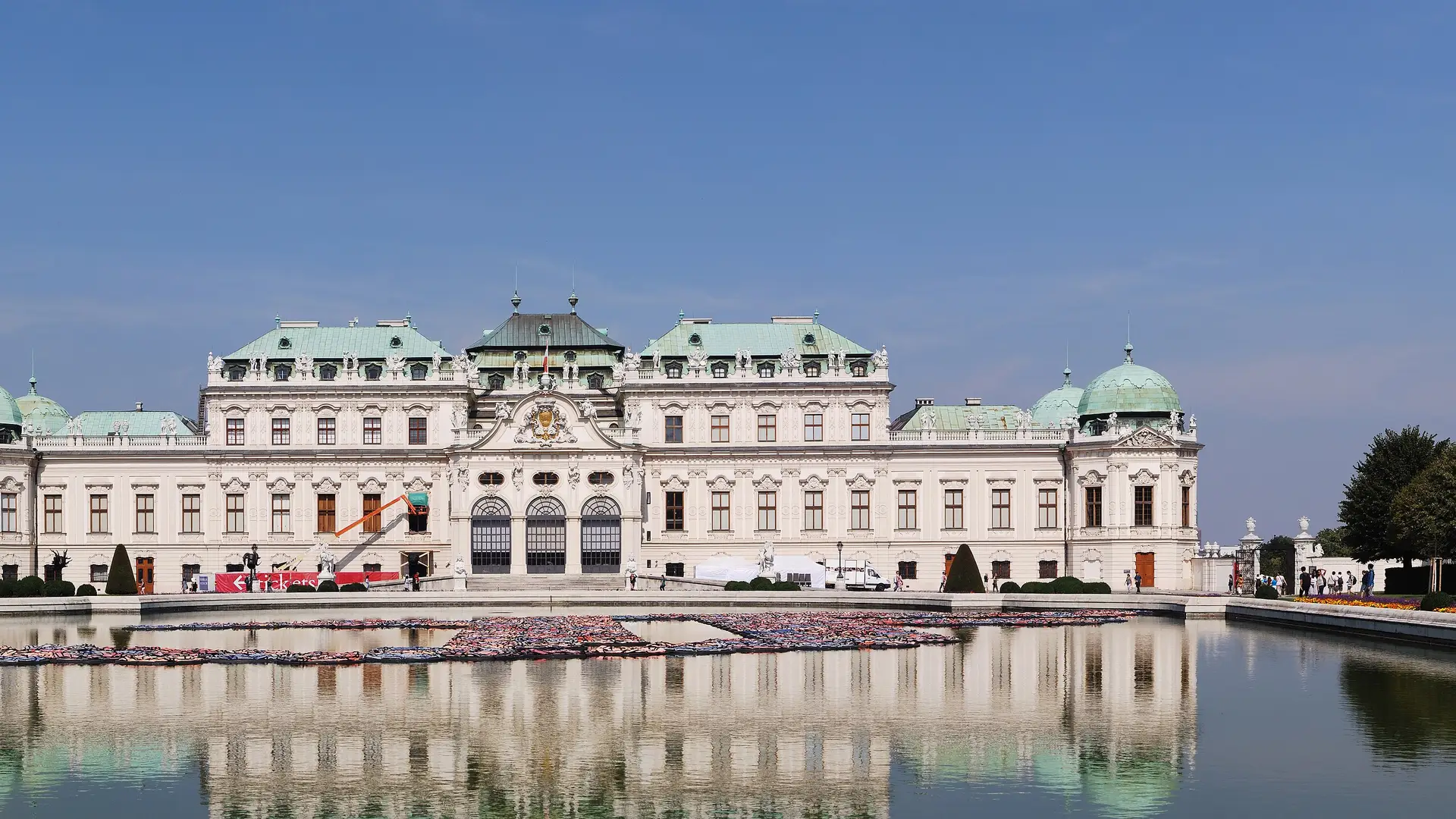
Klimt's The Kiss at the Belvedere: Where to Find It, When to See It, and What to Look At
Which room exactly, the best hour of the day, the models proposed for the female figure, the gold-leaf technique, and the wartime story that explains why The Kiss survived when fourteen of Klimt's other paintings did not.
Gustav Klimt's The Kiss (Liebespaar) is the single most-visited painting in Austria and one of the most reproduced images in twentieth-century European art. It hangs in the Upper Belvedere — not in the Marble Hall itself, as is sometimes stated, but in the Klimt gallery immediately adjacent to the Marble Hall, often referred to in older guides as the Goldenes Zimmer because of the painting's overwhelming gold-leaf surface. The panel measures one hundred and eighty centimetres square, much larger than the standard reproductions suggest, and was acquired by the Austrian state in 1908 directly from the Kunstschau Vienna exhibition for what was at the time an extraordinarily high price for a contemporary Austrian work. This guide is the practical concierge briefing: which room exactly, the best time to arrive, what is actually known about the model, what to look at on the panel beyond the obvious embrace, the gold-leaf technique that grew out of a 1903 trip to Ravenna, and the wartime story of Schloss Immendorf that explains why The Kiss survived when several of Klimt's other major paintings did not.
Exactly where The Kiss hangs in the Upper Belvedere
The Kiss is displayed on the first floor of the Upper Belvedere — the second floor by American counting — in the dedicated Klimt galleries that wrap around the building's central Marble Hall. From the main entrance, climb the grand staircase to the first floor and turn into the Marble Hall; the Klimt rooms open off the Marble Hall to either side. The Kiss has its own wall in one of these galleries, hung at standing height behind protective glass with museum-grade lighting calibrated to bring out the gold leaf without glare across the panel's surface.
A short rope barrier sets a comfortable viewing distance of roughly one and a half metres, which is the minimum needed to take in the full square format at a single glance. Older guidebooks sometimes describe the painting as hanging in the Marble Hall itself; this is incorrect — it is in the adjacent gallery, often labelled the Goldenes Zimmer in older floorplans. The Marble Hall is the room with the Carlone ceiling fresco and the panoramic view down the formal garden to St Stephen's spire across the old town; the Klimt gallery is the smaller, more intimate room next door. If you find yourself looking up at a painted ceiling fresco rather than at gold-leaf canvases, walk through the next doorway.
The best time of day to see The Kiss
Between roughly ten and eleven in the morning is the strongest single window for unhurried viewing. The first wave of opening-time visitors clears out of the Klimt rooms by about nine forty-five — they tend to come straight to The Kiss, photograph it, and move on — and the next major influx, the organised coach tours, arrives in volume from about eleven-thirty. The ten-to-eleven hour is the calmest of the morning. A second quiet window opens in the last hour before closing, particularly in months when the museum stays open until eighteen-hundred; the final forty-five minutes are often the second-quietest period of the day.
The twelve-to-fifteen window is the worst stretch of the day. Tour-bus arrivals stack up at the Upper Belvedere's main entrance, the queue at the ticket office can run forty-five minutes to an hour through July and August, and the room around The Kiss becomes crowded enough that taking an unobstructed photograph is difficult. Visitors with a flexible morning who arrive at nine o'clock opening can usually circle through the Klimt rooms first, drop down to the medieval and Baroque ground floor as the first tour groups arrive upstairs, then return to The Kiss between ten and eleven for a second, calmer look — a pattern that consistently delivers a better experience than a single linear pass.
Who is the woman in The Kiss?
The identity of the woman in The Kiss has been debated for over a century, and the honest answer is that there is no definitive answer. Three names recur most often in the art-historical literature. The first is Emilie Flöge, Klimt's lifelong companion and a leading figure in Vienna's reform-dress fashion scene; she modelled for several of Klimt's confirmed portraits and is the standing favourite in many catalogues. The second is Adele Bloch-Bauer, the Viennese socialite whose face is recorded in the two so-called Woman in Gold portraits; the argument here rests largely on facial proportion and the gold ornament shared between the works.
The third is Marie Henneberg, the wife of the photographer Hugo Henneberg and herself a prominent figure in Vienna's Secession circles; a Klimt portrait of her painted around 1901 has been cited as showing similar facial geometry. None of these identifications is conclusive, and Klimt himself never named the figure. The painting's title — Liebespaar, simply Lovers — is deliberately generic, and may have been intended to universalise the embrace rather than tie it to one individual. The current Belvedere wall text treats the question as open, which is the most honest curatorial position. Visitors who arrive expecting a single confirmed answer will leave with three plausible candidates and a useful lesson in art-historical method.
What to look at on the panel itself
Beyond the embrace, the panel rewards slow looking on at least four counts. First, the two halves of the gold field that frames the figures are not identical: the male half is filled with hard-edged rectangles in black, grey and silver, while the female half is filled with soft circles and floral spirals — a visual code Klimt used across the so-called Golden Period to distinguish masculine and feminine ornament. Second, the meadow on which the couple kneels is botanically specific, with daisies, violets and grasses identified by botanists as Austrian alpine meadow species, anchoring the abstract gold background in a real Austrian landscape.
Third, look at the woman's feet — only her toes emerge over the edge of the meadow into a void of gold, suggesting the precariousness of the kiss as much as its rapture. Several commentators have read the image not as a moment of unity but as the instant before one figure pulls away. Fourth, the man's halo of leaves and his ivy crown reference Dionysian and Christian iconography simultaneously, blending pagan vegetation imagery with the gold haloes of Byzantine icons. The gold-leaf surface is built up in multiple layers — gold, silver and platinum in different areas — applied by Klimt himself in a technique he developed during 1907 to 1909 directly inspired by the early-Christian mosaics he saw in 1903 in the Basilica of San Vitale at Ravenna.
How The Kiss survived: the Schloss Immendorf wartime story
The Kiss has been in the Belvedere collection since 1908, when the Austrian state bought it from the Kunstschau Vienna exhibition for twenty-five thousand crowns — an extraordinarily high price for a contemporary Austrian work at the time, and a deliberate political statement of support for Klimt and the secessionist generation. The painting hung in the gallery through the inter-war years without significant incident. The genuinely dramatic moment in its survival history is the Second World War, when the Belvedere — like most major European museums — evacuated its most valuable works to rural storage in 1943 and 1944.
Several Klimt canvases, including The Kiss, were sent to Schloss Immendorf in Lower Austria. In May 1945, in the final days of the war, retreating SS units set the schloss on fire; the building burned to the ground overnight and a substantial body of Klimt paintings stored there was destroyed, including the three Faculty Paintings — Philosophy, Medicine and Jurisprudence — commissioned for the University of Vienna and considered among Klimt's most ambitious large-scale works. The Kiss survived because it had been moved separately to a different protected store earlier that month, a decision documented in the Belvedere's wartime registry. Were it not for that single transfer, the painting almost certainly would not exist today. It returned to the Belvedere on the museum's post-war reopening and has been on continuous display since.
Frequently asked
What room is The Kiss in at the Belvedere?
The Kiss is displayed in the Klimt galleries on the first floor of the Upper Belvedere, immediately adjacent to the Marble Hall — not in the Marble Hall itself. The painting has its own wall in the gallery sometimes called the Goldenes Zimmer in older floorplans, behind protective glass.
When is the best time of day to see The Kiss without crowds?
Between roughly ten and eleven in the morning, or in the last hour before closing. The twelve-to-fifteen window is reliably the busiest, with tour-bus arrivals stacking up around the painting and ticket-office queues that can exceed forty-five minutes in summer.
How big is Klimt's The Kiss?
The panel measures one hundred and eighty centimetres square — substantially larger than most reproductions suggest. It is oil with real gold leaf, silver and platinum on canvas, in a square format, and is widely classed among Klimt's largest finished easel paintings.
Is The Kiss behind glass?
Yes. The painting is displayed behind protective museum-grade glass at standing height. A short rope barrier sets a viewing distance of approximately one and a half metres, which is the minimum needed to take in the full square format at a glance.
Can I take photos of The Kiss?
Yes, handheld photography without flash is permitted in the Klimt galleries under the operator's house rules. Tripods, flash and selfie sticks are not allowed anywhere in the Belvedere. Phone and ordinary cameras are fine; commercial or academic photography requires written permission from the Belvedere's communications department in advance.
Who is the woman in The Kiss?
Her identity has never been definitively established. The three names that recur most often in the literature are Emilie Flöge (Klimt's longtime companion), Adele Bloch-Bauer (the Woman in Gold sitter) and Marie Henneberg (a Secession-circle portrait subject from 1901). The current curatorial position treats the question as open.
When did Klimt paint The Kiss?
Between 1907 and 1908, during what art historians call his Golden Period. The painting was still unfinished when the Austrian state acquired it from the Kunstschau Vienna exhibition in the summer of 1908, and Klimt completed it shortly afterwards.
Has The Kiss ever left the Belvedere?
Rarely, and not for many decades. The painting spent the Second World War in protected storage and survived the 1945 fire at Schloss Immendorf that destroyed a substantial body of other Klimt works, including the three Faculty Paintings commissioned for the University of Vienna. It has been continuously on display at the Upper Belvedere since the museum's post-war reopening.
Is the gold on The Kiss real gold?
Yes. Klimt applied real gold leaf — and silver and platinum leaf in some areas — by hand, using techniques adapted from Byzantine icon-making after his 1903 visit to the early-Christian mosaics at San Vitale in Ravenna. The technique defines his so-called Golden Period of roughly 1907 to 1909.
What other Klimt paintings can I see at Belvedere?
The Upper Belvedere holds the world's largest Klimt collection, twenty-four paintings in total per the operator. Highlights include Judith I from 1901, the portrait of Sonja Knips from 1898, the portrait of Fritza Riedler, several of Klimt's Attersee landscape paintings, and a substantial body of his earlier academic work.