 Skip-the-line available
 The Marble Hall at the Upper Belvedere: Where Austria Got Its Freedom Back in 1955
Prince Eugene’s two-storey ceremonial hall, the 15 May 1955 signing that ended a decade of occupation, the balcony photograph the whole country knows — and how to read the room when you stand in it.
Most visitors climb the Upper Belvedere’s grand staircase with one painting in mind and walk straight through the most historically consequential room in Austria to reach it. The Marble Hall — the two-storey ceremonial hall at the centre of the palace’s garden front, sheathed in red-brown marble beneath a painted ceiling — is where, on 15 May 1955, the foreign ministers of four occupying powers and of Austria signed the Austrian State Treaty, restoring the country as a free, sovereign and democratic state after seventeen years of annexation, war and occupation. The Klimt galleries open directly off this hall; The Kiss hangs a few paces away. This guide gives the room its due: what Prince Eugene of Savoy built it for in the 1720s, what happened beneath its fresco on that May morning in 1955 and in the extraordinary ten weeks that followed, the earlier lives of the hall — a masked ball for Marie Antoinette among them — and what to actually look at when you stand on the marble yourself. Every date here is drawn from the sources listed at the end; the room needs no embellishment.
Prince Eugene’s ceremonial centrepiece
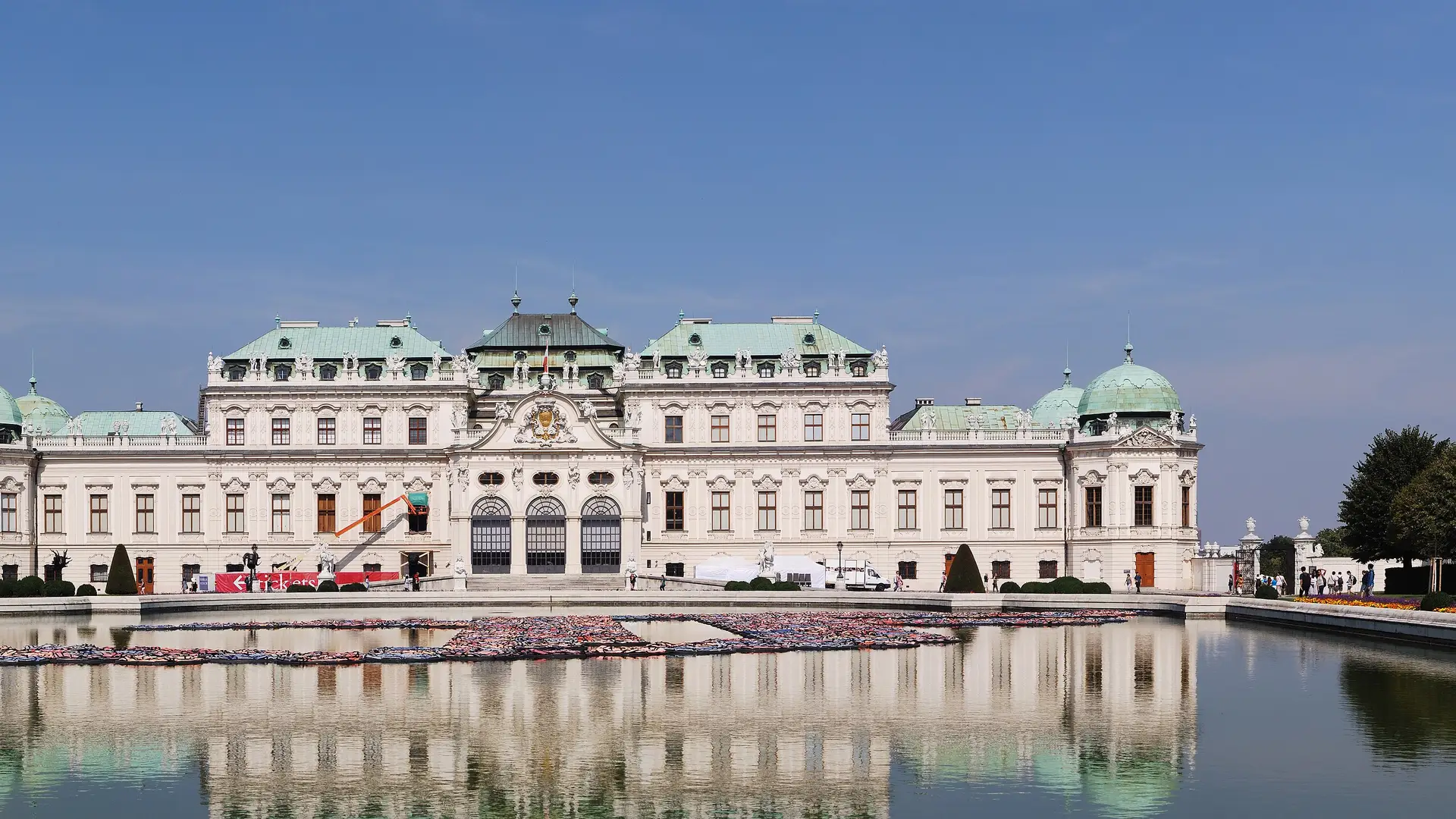
The Upper Belvedere was completed in 1723 as the crowning element of the summer estate of Prince Eugene of Savoy (1663–1736), the Habsburg field marshal whose victories against the Ottoman Empire made him one of the richest and most influential men in Europe. Eugene passed over the court’s favourite architect, Johann Bernhard Fischer von Erlach, and gave the commission to Johann Lucas von Hildebrandt, who had served as his military engineer. Hildebrandt answered with a palace that is really a stage set: a long garden facade whose entire composition funnels toward the central hall on the upper floor, with Dominique Girard — trained in the gardens of Versailles — laying out the formal terraces that descend toward the Lower Belvedere.
The Marble Hall is that central hall. It rises through two storeys at the middle of the garden front, faced in the red-brown marble that gives it its name, worked with gilding and crowned by a ceiling fresco glorifying its builder. Tall windows on the garden side open onto the sightline Hildebrandt engineered: down the terraced parterres, over the Lower Belvedere’s roofline, and out to the towers of Vienna — a vista so celebrated that the view from the garden below, painted by Bernardo Bellotto in the eighteenth century, is still known in Vienna as the Canaletto view. Eugene used the hall for receptions and display; it was built to impress ambassadors, and it has never stopped doing that job.
15 May 1955: four ministers, one signature each
Austria emerged from the Second World War occupied by the four Allied powers, its territory and its capital divided into zones — an arrangement that hardened with the Cold War and lasted a full decade. Negotiations for a treaty dragged across years of East–West deadlock before breaking loose in the spring of 1955. On the morning of 15 May 1955, the foreign ministers converged on the Upper Belvedere: Vyacheslav Molotov for the Soviet Union, John Foster Dulles for the United States, Harold Macmillan for the United Kingdom, Antoine Pinay for France, and Leopold Figl for Austria. In the Marble Hall they signed the Austrian State Treaty, whose text declared the re-establishment of Austria as a free, sovereign and democratic state.
What fixed the day in national memory happened at the windows. Before a crowd filling the palace garden, Leopold Figl displayed the signed treaty from the Belvedere’s balcony — the image of the raised document against the Marble Hall’s facade became one of the defining photographs of the Austrian twentieth century. Figl’s famous three words, ‘Österreich ist frei’ — Austria is free — are inseparable from that balcony image in popular memory, though accounts place their delivery during the ceremony itself; either way, they belong to this building. For a state whose modern existence had been erased in 1938, the sentence and the setting did more than any clause of the treaty to tell Austrians the occupation was over.
The choice of venue was itself a statement. The signing did not take place in a ministry or a parliament chamber but in the ceremonial hall of a Baroque summer palace that had, by then, been a public art museum for generations — a room associated with Austria’s cultural patrimony rather than with any recent regime. Standing in the hall today, it takes little effort to reconstruct the scene: the treaty table beneath the fresco, the ministers’ delegations along the marble walls, and beyond the glass, the garden full of people waiting for three words.
What the treaty did — and the ten weeks that followed
The signatures of 15 May began a precisely choreographed unwinding. The treaty entered into force on 27 July 1955, starting the clock on the withdrawal of the occupying forces. By 25 October 1955 the last Allied troops had left Austrian territory, and on the following day — 26 October 1955 — the Austrian Parliament enacted the constitutional law declaring the country’s permanent neutrality, a status Austria maintains to this day. The 26th of October became Austria’s national holiday, commemorating the neutrality declaration.
The sequence matters for understanding why the Belvedere holds the place it does in Austrian civic memory. The State Treaty was not a peace treaty in the classic sense — Austria was treated as a state re-established rather than an enemy defeated — and the neutrality law that anchored the settlement was passed by Austrians in their own parliament, one day after the last foreign soldier departed. The Marble Hall is thus the opening scene of a ten-week national drama that ended with a sovereign, neutral republic. Anniversary years bring wreaths, school groups and television crews back to the room; on 15 May, expect the hall to feature prominently in whatever the museum has programmed.
The hall’s other two centuries: a ball for Marie Antoinette and one of the world’s first public museums
Prince Eugene died in April 1736 without a legally binding will, and the estate passed to his niece, Princess Maria Anna Victoria of Savoy, who moved into the Belvedere that July and soon sold it on. In 1752 Empress Maria Theresa acquired the ensemble for the imperial house, and under her the palace hosted one of the most storied festivities in its history: in 1770, a masked ball held to celebrate the marriage of her daughter, Archduchess Maria Antonia — the future Marie Antoinette — to the Dauphin of France. The galleries and hall that today hold quiet rows of paintings once held one of the largest court celebrations of the century.
The palace’s conversion into a museum came astonishingly early. In 1776 Maria Theresa and her son, Emperor Joseph II, decided to transfer the Imperial Picture Gallery from the Stallburg wing of the Hofburg to the Upper Belvedere, and around 1781 the collection was opened to the public — making the Belvedere one of the first public museums in the world, decades before the Louvre’s revolutionary opening or the founding of most national galleries. That lineage runs unbroken to the Österreichische Galerie Belvedere of today. The building’s last imperial chapter came in 1896, when Emperor Franz Joseph I designated the Upper Belvedere the official residence of the heir to the throne, Archduke Franz Ferdinand — the man whose assassination in Sarajevo in 1914 detonated the First World War. The palace has watched the Austrian twentieth century from unusually close range.
Standing in it today: how to read the room
The Marble Hall sits on the Upper Belvedere’s first floor, directly at the top of the grand staircase, with the Klimt galleries opening off it — you will pass through or beside it on any normal route to The Kiss, and it is included in the standard Upper Belvedere admission with a timed-entry ticket. The practical advice mirrors the Klimt rooms: come at the 09:00 opening or late in the day, when you can stand in the centre of the marble floor without a crowd, look up into the fresco, and take in the double-height space as Hildebrandt intended. At midday in high season the hall functions mostly as a corridor, which is a poor fate for the most important room in the republic.
Three things reward attention. First, the floor-to-fresco verticality: the hall is one of the few places in the palace where you experience the full two-storey height of the garden front from inside. Second, the windows: the balcony beyond them is the one from the 1955 photographs, and the view down the garden axis toward the city is the palace’s founding gesture — the prince’s panorama, the reason the estate is called Belvedere at all. Third, the room’s restraint compared with its cargo of history: no throne, no rope-line theatre, just marble, gold and light. Photography for private, non-commercial purposes is permitted here as in the rest of the museum, without flash, tripods or selfie sticks, per the operator’s house rules. Give the hall ten minutes; almost nobody does, and it shows them.
One disambiguation spares you a wrong turn: the Marble Hall of the 1955 signing is in the Upper Belvedere, and it is not the same room as the Marble Gallery in the Lower Belvedere. The Lower palace — Prince Eugene's actual residence, a ten-to-twelve minute walk down the garden axis — contains its own suite of Baroque state rooms, the Marble Gallery, the Hall of Grotesques and the Golden Room among them, which today frame the museum's temporary exhibitions. They are worth the walk, and a combined visit lets you compare Hildebrandt working at residential scale downhill with Hildebrandt working at ceremonial scale uphill. But the treaty room, the balcony and the fresco are all in the Upper palace, one floor above the entrance, and no itinerary built around the 1955 story needs to leave that building. Visitors with a serious interest in the period should also simply look at the hall's floor and doorways slowly: this is one of the rare rooms in Europe where the furniture of a continent-defining event — the space, the light, the marble — survives essentially as the cameras recorded it.
Frequently asked
What was signed in the Marble Hall at Belvedere?
The Austrian State Treaty, signed on 15 May 1955 by the foreign ministers of the Soviet Union, the United States, the United Kingdom and France together with Austria’s foreign minister Leopold Figl. It re-established Austria as a free, sovereign and democratic state and ended the four-power occupation in place since 1945.
Who signed the Austrian State Treaty in 1955?
Vyacheslav Molotov for the Soviet Union, John Foster Dulles for the United States, Harold Macmillan for the United Kingdom, Antoine Pinay for France, and Leopold Figl for Austria. The signing took place in the Marble Hall of the Upper Belvedere on 15 May 1955, with Figl then displaying the treaty to the crowds from the balcony.
When did Austria become neutral?
On 26 October 1955, when the Austrian Parliament enacted the constitutional law declaring permanent neutrality — one day after the last Allied troops left Austrian territory on 25 October. The treaty itself had entered into force on 27 July 1955. The 26th of October remains Austria’s national holiday.
Can you visit the Marble Hall today?
Yes. The Marble Hall is on the first floor of the Upper Belvedere at the top of the grand staircase, with the Klimt galleries opening off it, and is included in standard Upper Belvedere admission with a timed-entry ticket. It is quietest at the 09:00 opening and in the last hour of the day.
Did Marie Antoinette really celebrate her wedding at Belvedere?
A masked ball was held at the palace in 1770 to mark the marriage of Archduchess Maria Antonia — the future Marie Antoinette — to the Dauphin of France, during the era after Empress Maria Theresa acquired the Belvedere in 1752. It is one of several imperial chapters in the building’s history, alongside Franz Ferdinand’s residency from 1896.
Is the balcony from the 1955 photographs visible on a visit?
The balcony sits on the garden side of the Marble Hall, beyond its tall windows — you see it from inside the hall and from the garden parterres below, where the crowds stood on 15 May 1955. Access onto the balcony itself is not part of the normal visitor route, but the windows give you Figl’s exact vantage over the garden axis toward the city.